What a Composite Deck Costs in Calgary
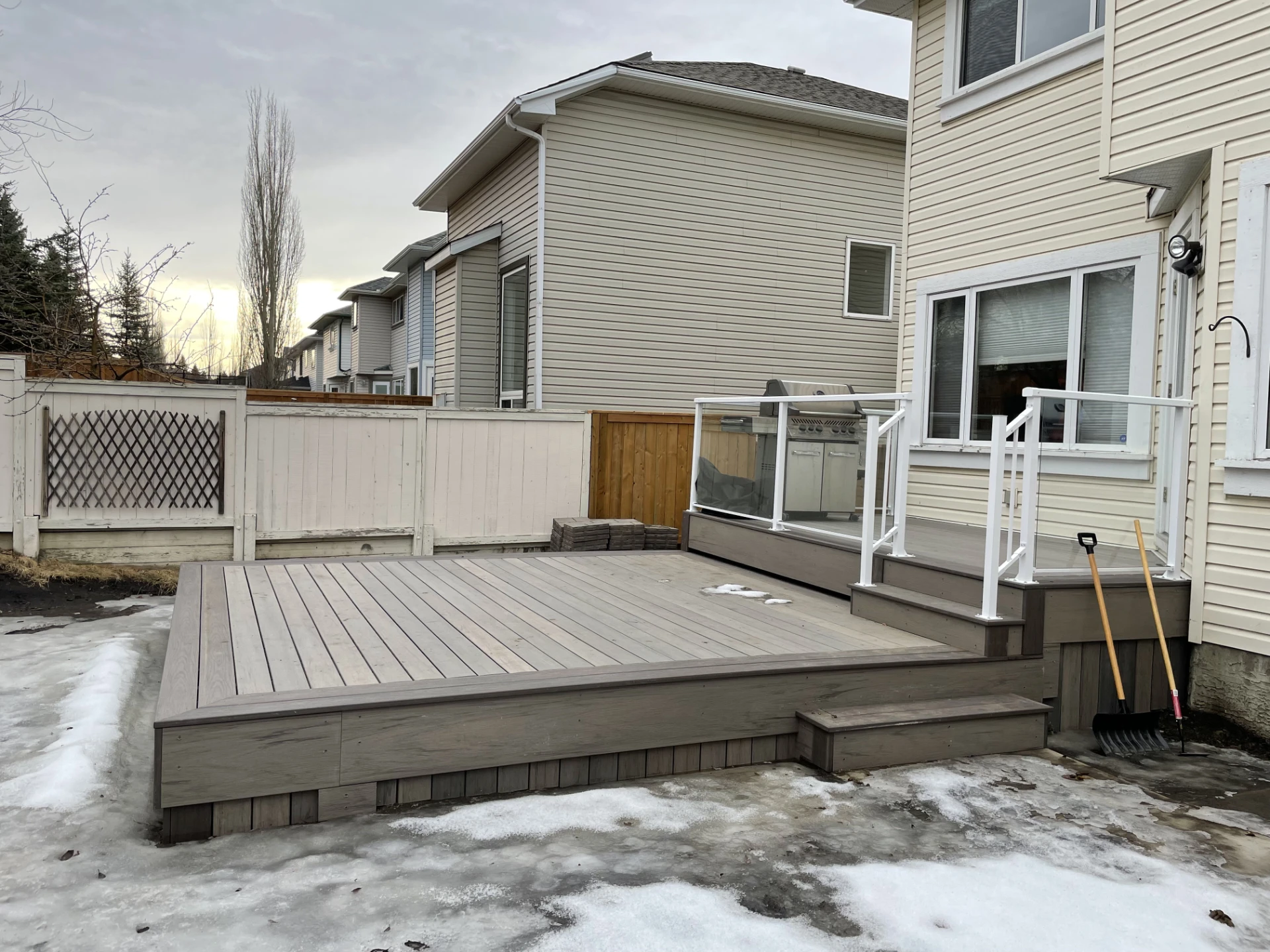
A composite deck costs $42 to $58 per square foot installed in Calgary — $6,048 to $8,352 for a 12 × 12, and $16,800 to $23,200 for a 20 × 20. It's the most expensive deck we build.
It's also, over a long enough horizon, the cheapest one to own. Both things are true and the gap between them is the whole reason this page exists.
Cost by size
| Deck size | Sq ft | Installed cost |
|---|---|---|
| 10 × 10 | 100 | $4,200 – $5,800 |
| 12 × 12 | 144 | $6,048 – $8,352 |
| 12 × 16 | 192 | $8,064 – $11,136 |
| 14 × 20 | 280 | $11,760 – $16,240 |
| 16 × 20 | 320 | $13,440 – $18,560 |
| 20 × 20 | 400 | $16,800 – $23,200 |
Why the range is so wide
$42 and $58 are both composite. A 38% spread on the same material is wider than any other decking we build, and it comes down to four things.
The board line. Entry-level composite and a premium capped board are different products at different prices. Trex, TimberTech, Fiberon and Deckorators each run several tiers — the budget lines have simpler grain and shorter warranties, the top lines have multi-tonal colouring and deeper embossing. Trex's best decking lines carry a 50-year limited residential warranty. The board alone can move the job $8 to $12 a square foot.
The railing. Composite decks usually get aluminium or glass rather than wood picket, because wood railing on a composite deck defeats the point. Frameless glass is the single biggest line item on most composite quotes after the decking itself.
Hidden fasteners. Standard on composite, and they cost more in both clips and labour than face screwing. They're also why the deck looks the way it does, so this isn't a place to save.
Substructure. Composite needs tighter joist spacing than wood framing — the board has to be properly supported or it feels soft underfoot regardless of what it cost. More joists, more cost, and it's not visible in the finished deck.
What it costs to own — nothing
This is the argument, and it's arithmetic rather than opinion.
Composite doesn't get stained. Ever. A wood deck needs refinishing every one to three years at $500 to $900 a time professionally — five to eight times over fifteen years. Composite gets washed.
And it lasts. Trex carries limited residential warranties from 25 to 50 years depending on the line; TimberTech's composite collections carry 25-year product and fade-and-stain warranties. Those are warranty terms in writing, not estimates.
A wood deck in Calgary lasts 15 to 20 years before it needs replacing, so across thirty years it gets built twice. A composite deck gets built once.
That's why the most expensive deck to buy can be the cheapest to own — and it's laid out in full, with the thirty-year numbers, in composite vs wood decking.
Why it suits Calgary specifically
The case for composite is stronger here than in most of the country, and it isn't about the warranty.
Water can't get into it. Capped composite is sealed on its exposed faces. Freeze-thaw damage in a wood deck begins with water entering the board and then expanding. Remove the absorption and you remove the mechanism.
No checking. Wood develops fine surface splits as it cycles, and those are the beginning of the end. Composite doesn't check or splinter.
UV protection is built in, not applied. A stain is a sacrificial layer that burns off. Composite fade resistance is in the cap, and it's what the fade warranty covers.
Our building season is short. Restaining means finding a dry stretch warm enough to cure, in a window that isn't long. Skipping two years because the weather didn't cooperate is how wood decks age faster than they should. Composite removes that problem entirely.
Where it isn't the right call
If you're moving inside ten years, the long-horizon maths isn't yours to collect. Build in pressure treated and spend the difference elsewhere.
If you want real wood, composite isn't it. Current capped boards have convincing grain and none of the plastic sheen of early generations, but it isn't cedar, and if that matters to you it matters.
Installation matters more here than with wood
Composite is less forgiving. It expands and contracts more along its length, so gapping and fastener choice matter. Hidden-fastener systems have to be set correctly or the boards telegraph every mistake. Joist spacing is tighter than wood framing.
Done properly it's the best-value deck you can build in this city. Done carelessly it's an expensive deck with a bounce in it — and unlike a wood deck, you can't sand and refinish your way out of it.
Getting it built
We work with Trex, TimberTech, Fiberon and Deckorators. See composite decks in Calgary for how we build them, or how much a deck costs in Calgary for every material side by side.
Get a price on your deck
We’ll come out, measure, and quote your actual site — permits included.
Get My Free Quote